

Balsa Wood Market to Hit USD 496.5 Million by 2035 at 5.6% CAGR
Balsa Wood Market
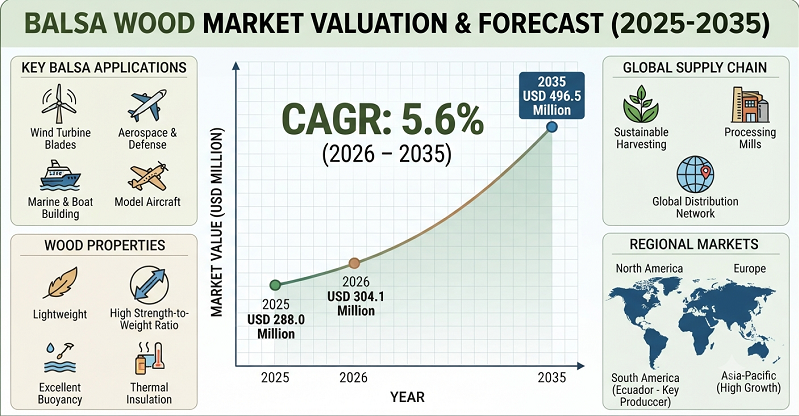
According to the latest Market Research Future analysis, the global balsa wood market was valued at approximately USD 288.0 million in 2025. The market is projected to reach USD 496.5 million by 2035, expanding at a 5.6% CAGR from 2026 to 2035.
What Is Balsa Wood?
Balsa is a lightweight hardwood obtained from the Ochroma tree. Its combination of low density and structural performance makes it useful in applications where reducing weight is a priority.
Balsa wood is commonly processed into blocks, sheets, core materials, and specially shaped components. In composite structures, it can be positioned between stronger outer skins to create lightweight sandwich panels.
Its major advantages include:
Very low weight
High strength-to-weight ratio
Good shear strength
Good energy absorption
Thermal and acoustic insulation properties
Easy machining and shaping
Compatibility with composite manufacturing
These characteristics have made balsa particularly valuable in wind-energy blades, marine structures, aerospace applications, and other lightweight composite products.
Balsa Wood Market Growth
The growing demand for lightweight materials is one of the principal factors supporting the balsa wood market.
The wind-energy sector represented approximately 47.8% of market revenue in 2025, making it the largest application segment. Balsa is widely used as a structural core in composite wind-turbine blades because it provides a combination of low weight and mechanical performance.
The expansion of offshore wind energy is creating additional opportunities. Larger turbine blades require advanced lightweight structural materials, increasing demand for engineered balsa core products.
Aerospace and aviation is another promising application, with the segment projected to grow at approximately 7.9% CAGR through 2035.
Get Sample @ https://www.marketresearchfuture.com/sample_request/4473
Key Trends in the Balsa Wood Market
Growing Demand from Wind Energy
Wind energy is expected to remain the most important growth driver for balsa wood.
As wind turbines become larger, manufacturers require lightweight materials capable of handling significant mechanical loads. Balsa core materials can help reduce structural weight while maintaining the stiffness and strength required for large composite blades.
The continued expansion of offshore wind projects is particularly important because offshore turbines are becoming larger and more powerful.
Increasing Adoption of Sustainable Materials
Sustainability is becoming increasingly important in material selection.
Balsa is a renewable natural material and can provide an alternative to some petroleum-derived synthetic foam cores. Responsible plantation management and traceable sourcing are becoming increasingly important as manufacturers and OEMs strengthen environmental requirements.
Forest certification and supply-chain traceability are consequently becoming important considerations in the balsa industry.
Lightweighting in Marine Applications
Marine manufacturers are increasingly focused on reducing vessel weight to improve fuel efficiency, range, and performance.
Balsa core materials are used in boat hulls, decks, superstructures, and other composite structures. The marine segment generated approximately USD 61.9 million in revenue in 2025.
The increasing use of sandwich construction in recreational and commercial vessels is expected to support future demand.
Growth of Advanced Aerospace Applications
Aerospace manufacturers require materials that offer low weight while maintaining structural performance.
Balsa can be used in selected composite panels, interior components, and structural applications. Emerging advanced-air-mobility and electric-aircraft programs could provide additional opportunities for lightweight core materials.
Although aerospace volumes are considerably smaller than wind-energy volumes, specialized applications can generate higher-value demand.
Automation and Pre-Shaped Core Materials
The market is gradually shifting from basic raw balsa blocks and sheets toward value-added products.
Pre-shaped and contour-cut components can reduce material waste and simplify composite manufacturing. Automated cutting and kitting can also improve production efficiency for large wind-turbine blades.
Pre-shaped kits are forecast to grow at approximately 7.6% CAGR, making them the fastest-growing product form in the report.
Major Companies in the Balsa Wood Market
The competitive landscape includes companies specializing in balsa core materials, composite technologies, processing, and engineered structural solutions.
Key companies identified in the Market Research Future report include:
3A Composites Core Materials
Gurit Holding AG
DIAB Group
CoreLite Inc.
Plantabal S.A.
Balsaflex Ecuador
Competition is increasingly based on material quality, processing capabilities, supply reliability, certification, sustainability, and the ability to provide customized core solutions.
Buy Now @ https://www.marketresearchfuture.com/checkout?currency=one_user-USD&report_id=4473
Opportunities in the Balsa Wood Market
Offshore Wind Expansion
The continued expansion of offshore wind represents one of the largest opportunities for balsa producers and processors.
Larger turbine blades require lightweight structural cores, while the increasing scale of offshore projects can create significant demand for engineered balsa products.
Asia-Pacific Localization
The expansion of wind-turbine manufacturing in Asia creates opportunities for regional balsa processing and finishing facilities.
Local processing can reduce transportation costs, shorten lead times, and allow suppliers to provide customized core kits directly to blade manufacturers.
Hybrid Balsa-P to price volatility during periods of demand growth or reduced harvest availability. Balsa plantations require several years before trees reach harvestable maturityET Structures
Hybrid structures combining balsa and recycled PET or other synthetic cores are emerging as an important area of development.
Such systems can combine the structural and damping characteristics of balsa with the dimensional consistency of synthetic materials.
Circularity and Recycling
The increasing focus on wind-turbine blade recycling creates opportunities for manufacturers developing core materials that can be more easily separated or processed at end of life.
Developing recycle-ready formulations and documented material compositions could become an important competitive advantage.
Traceability and Sustainable Sourcing
Traceable plantation sourcing is becoming increasingly valuable.
Manufacturers that can demonstrate responsible forestry practices, certification, geographic origin, and supply-chain transparency may be better positioned to meet the requirements of major OEMs and infrastructure projects.
Challenges Facing the Market
Despite its growth potential, the balsa wood industry faces several challenges.
Supply Concentration
A significant portion of global balsa production is concentrated in Ecuador. This creates exposure to weather events, agricultural conditions, logistics disruptions, and changes in regional production.
Supply concentration can also contribute to price volatility during periods of demand growth or reduced harvest availability.
Competition from Synthetic Foam
PET, PVC, and other synthetic foam materials compete directly with balsa in composite-core applications.
Synthetic foams can offer consistent density and predictable processing characteristics, while balsa can provide advantages in shear strength, weight, and sustainability.
The growing use of hybrid structures may become a way for manufacturers to combine the advantages of both materials.
Plantation Rotation Periods
Balsa plantations require several years before trees reach harvestable maturity.
This creates a supply-planning challenge because producers cannot immediately increase output in response to sudden increases in demand.
Long-term plantation planning and investment are therefore critical for maintaining supply stability.
Density Variability
Because balsa is a natural material, its density and properties can vary.
Manufacturers may need to use sorting, inspection, and quality-control processes to ensure that material meets the specifications required for advanced composite applications.
Transportation Costs
Balsa is extremely lightweight but relatively bulky. Transportation can therefore represent a significant portion of delivered costs.
Local processing and regional finishing facilities can help reduce logistics costs and improve supply-chain efficiency.
Read More @ https://www.marketresearchfuture.com/reports/balsa-wood-market-4473
Future Outlook
The global Balsa Wood Market is expected to maintain steady growth through 2035.
Market Research Future estimates that the market will increase from USD 288.0 million in 2025 to USD 496.5 million in 2035, representing a 5.6% CAGR from 2026 to 2035.
Wind energy will remain the central source of demand, particularly as offshore turbines increase in size and capacity. Aerospace, marine, transportation, and advanced composite applications will provide additional growth opportunities.
At the same time, the industry is likely to move toward greater product specialization. Pre-shaped kits, engineered core assemblies, hybrid structures, and digitally traceable materials are expected to gain importance.
Sustainability will also remain a key consideration. Responsible plantation management, certification, supply-chain transparency, and end-of-life solutions will increasingly influence purchasing decisions.
Browse More Reports:
Quaternary Ammonium Compounds Market https://www.marketresearchfuture.com/reports/quaternary-ammonium-compounds-market-12081
Aramid Fiber Market https://www.marketresearchfuture.com/reports/aramid-fiber-market-5868
Wood Plastic Composites Market https://www.marketresearchfuture.com/reports/wood-plastic-composites-market-8311
carbon offsets market https://www.marketresearchfuture.com/reports/carbon-offsets-market-23139
plastic lumber market https://www.marketresearchfuture.com/reports/plastic-lumber-market-28854
Market Research Future
Market Research Future
+1 855-661-4441
email us here
Legal Disclaimer:
EIN Presswire provides this news content "as is" without warranty of any kind. We do not accept any responsibility or liability for the accuracy, content, images, videos, licenses, completeness, legality, or reliability of the information contained in this article. If you have any complaints or copyright issues related to this article, kindly contact the author above.
